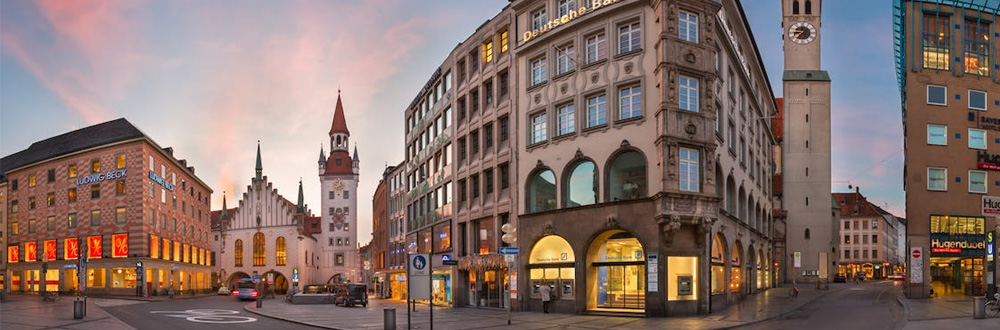
Munich is the capital of Bavaria and Germany's third-largest city, situated along the Isar River just north of the Alps. Known for its exceptional quality of life, the metropolis combines a robust global economy—driven by engineering, technology, and finance sectors—with deeply preserved cultural traditions. Beyond its modern corporate footprint, the city centers around historic architecture, sprawling public green spaces like the English Garden, and world-class museums, making it a primary hub for European commerce and tourism.
Marienplatz is the historic center of Munich’s Old Town and the city's primary focal point. The square is anchored by the Neues Rathaus (New Town Hall), home to the famous Glockenspiel clock tower. This mechanical icon draws crowds daily at 11 AM, 12 PM, and 5 PM with its historical figures and musical chimes. Beyond the architecture, Marienplatz serves as a central gathering space filled with cafes, shops, street performers, and seasonal markets. Highly walkable and well-connected, the square remains the definitive starting point for exploring Bavarian culture and local city life.
Larger than New York’s Central Park, the Englischer Garten is where Munich comes to unwind. Spanning 910 acres right from the city center, it trades manicured lawns for a wilder, English-style landscape. Walk south to catch local river surfers riding the freezing, stationary Eisbach wave year-round, or hike up to the Greek-style Monopteros temple for the best sunset views over the city’s spires. If you want a classic Bavarian afternoon, skip the crowded indoor halls and grab a bench at the massive beer garden surrounding the park's historic Chinese Tower. It is the ultimate local escape.
Dating back to 1589, the Hofbräuhaus is the ultimate theater of Bavarian beer culture. Step inside the ground-floor Schwemme, a massive, vaulted beer hall where brass bands play under painted ceilings and regulars lock away their personal beer steins in private iron cages. It is loud, historic, and unpretentious. While the standard move is to order a massive one-liter Maß of original Helles lager alongside a giant baked pretzel, you can escape the tourist heavy crowds by heading up to the quieter first-floor festive hall or taking a bench in the walled courtyard beer garden out back.
Just a two-minute walk from Marienplatz, the Viktualienmarkt is Munich’s premier open-air food market. Operating since 1807, this 140-stall plaza has evolved from a traditional farmer's market into a gourmet open-air food hall. Look up to spot the blue-and-white Bavarian maypole (Maibaum) at its center, which dictates the layout. It is the perfect spot to assemble a DIY lunch: grab artisan cheeses, local ham, and fresh pretzels from the stalls. Afterward, head to the central beer garden, the only one downtown that rotates beers from all six of Munich's major historic breweries.
Sited on a dedicated island in the Isar River, the Deutsches Museum is the world’s largest science and technology museum. Spanning over half a million square feet, it is a masterclass in German engineering. Skip the standard tourist brochures and head directly to the massive aviation hall to walk among early aircraft, or descend into the immersive, life-sized replica of a dark coal mine. Insider Tip: Because navigating all fifty exhibition areas takes days, buy your tickets online to bypass the main bridge queues and strictly focus your visit on two or three specific wings.
Commissioned in 1664, Nymphenburg Palace is a sprawling Baroque masterpiece that served as the summer residence for Bavarian rulers. While the grand facade stretches wider than Versailles, the real highlights sit tucked inside. Step into the central Stone Hall (Steinerner Saal) to view the massive, intricate Rococo ceiling frescoes, then wander over to the famous Gallery of Beauties painting collection. Local Tip: Skip the costly indoor-only ticket and prioritize exploring the 490-acre palace grounds. Navigating the central canal brings you to hidden, miniature forest pavilions.
Housed in a striking, futuristic silver bowl near the Olympic grounds, the BMW Museum tracks a century of automotive engineering. The interior uses a unique, circular ramp system that guides you through decades of iconic vehicles, racing prototypes, and sleek concept cars. Insider Tip: Don’t mistake this for the neighboring BMW Welt. While the museum requires a ticket to view the heritage collection, the spectacular BMW Welt across the footbridge is entirely free to enter. Check out the museum's legendary M-series display first, then cross over to sit inside the newest production cars.
Built for the 1972 Summer Games, Olympiapark remains a masterclass in modern urban design. The park is world-renowned for its revolutionary, sweeping tent-style acrylic glass roofs that seamlessly drape over the stadium, hall, and aquatic center. Beyond the striking architecture, it serves as a massive activity hub. Local Tip: Skip the standard walking paths and book an official guided roof climb to walk directly along the stadium’s canopy ropes. Afterward, take the elevator up the 291-meter Olympic Tower (Olympiaturm) for panoramic views that stretch across the Munich skyline.
Located two hours southwest of Munich, Neuschwanstein Castle is the ultimate alpine day trip. Commissioned by King Ludwig II in 1869, this fairytale fortress inspired Disney’s Sleeping Beauty castle. The exterior is jaw-dropping, but navigating the crowds requires strategy.
Insider Tip: You must reserve your interior tour tickets weeks in advance online; day-of tickets at the Hohenschwangau village booth sell out almost instantly. Once there, skip the crowded shuttles and hike thirty minutes up the steep trail. Walk directly onto the Marienbrücke (Mary’s Bridge) for the absolute best postcard view of the castle hanging over the Pöllat Gorge.
Located 25 minutes northwest of Munich via the S-Bahn, Dachau serves as a crucial, deeply somber historical excursion. Established in 1933, it was the first Nazi concentration camp and became the administrative model for the entire camp system.
Visitor Guidance: Plan to spend at least three hours here. Start at the main exhibition center inside the former maintenance building, then walk the path between the reconstructed barracks to the crematorium area. Because of the intense nature of the graphic historical exhibits and audio tours, the memorial officially recommends that visitors be at least 14 years old.